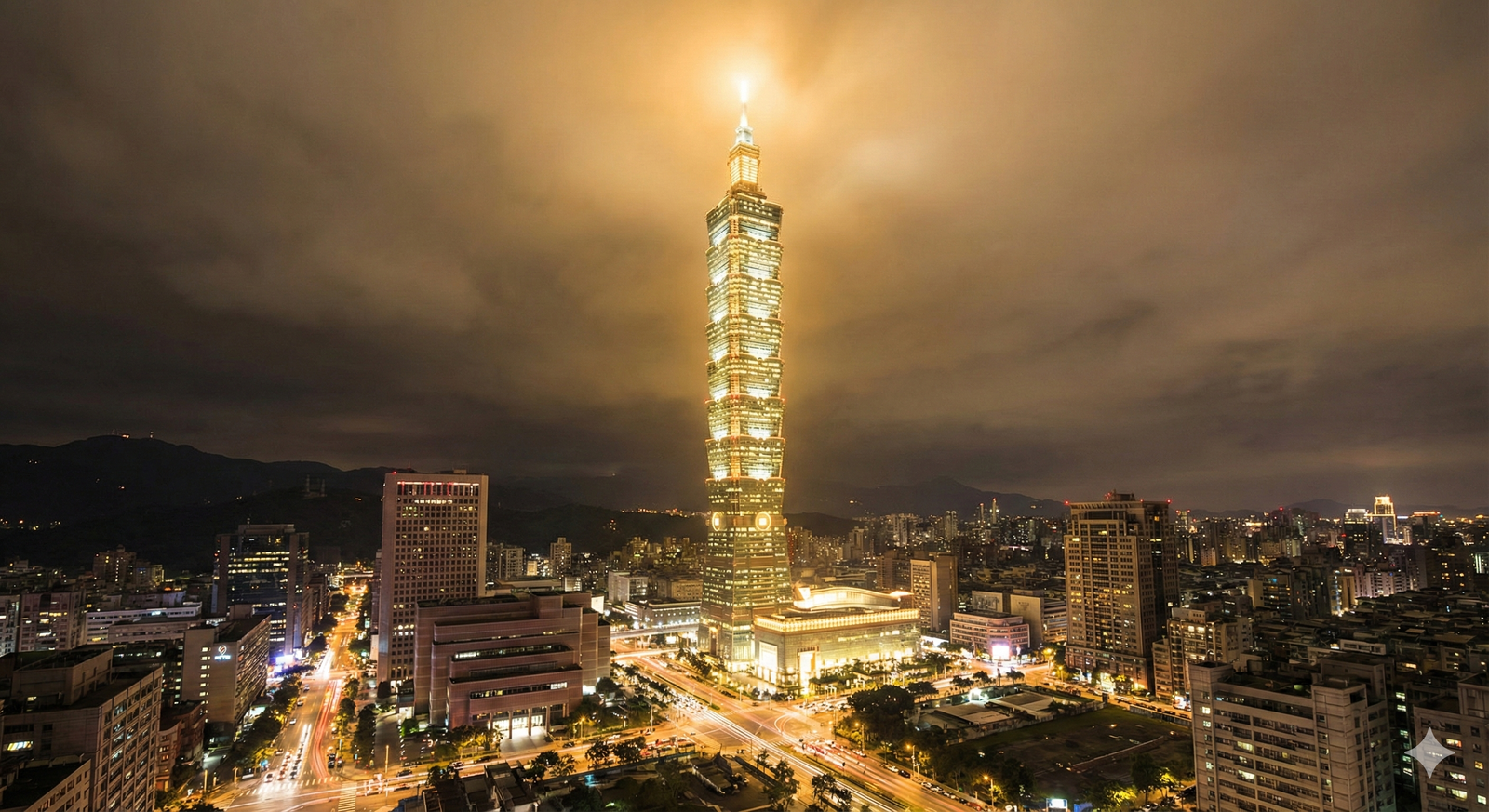
Taiwan is not a slogan, a bargaining chip, or a “situation.” It is a functioning state with a defined territory, permanent population, effective government, independent courts, a military chain of command, its own currency and fiscal authority, and the ability to sign and execute international agreements, even if many are labeled “unofficial” to satisfy other capitals’ domestic politics. The world can continue to debate labels, but it cannot plausibly deny the operating reality: Taiwan governs Taiwan.
That reality matters because the dispute that shapes policy debates in Washington, Tokyo, Canberra, Brussels, and beyond is not about abstract history. It is about whether 23 million people can keep choosing their own government without coercion. Taiwan’s democratic evolution has made that question more visible, more morally legible, and harder to evade.
From martial law to a competitive democracy
Taiwan’s modern political identity is built on a long transition away from authoritarian rule. Martial law was lifted on July 15, 1987, ending a decades long period of emergency governance and opening space for opposition politics, civil society, and eventually full electoral competition.
Less than a decade later, Taiwan held its first direct presidential election on March 23, 1996, a milestone that made popular sovereignty the system’s foundation, not a rhetorical ornament. Voter participation in these presidential contests has remained high by global standards, a proxy for both legitimacy and civic buy in. Turnout was about 76.0% in 1996, 82.7% in 2000, 80.3% in 2004, and 76.3% in 2008.
In the consolidated democratic era, turnout fluctuates but remains robust: 74.4% in 2012, 66.3% in 2016, 74.9% in 2020, and 71.9% in 2024. Those are not the numbers of an apathetic “region.” They are the numbers of a political community that expects to choose, argue, replace leaders, and keep doing it.
Identity is moving in one direction
National identity is where the practical and the political fuse. Here the trend line is stark, especially among younger Taiwanese.
Pew Research Center polling released January 16, 2024 found that 67% of adults in Taiwan identify as primarily Taiwanese, 28% as both Taiwanese and Chinese, and 3% as primarily Chinese. Pew also reports a strong age gradient, with younger adults far more likely to identify as Taiwanese.
Taiwan Public Opinion Foundation (TPOF) data adds granularity. In surveys conducted December 9 to 11, 2024 and January 12 to 14, 2025, TPOF found that 76.1% of adults identify as Taiwanese, 9.0% as both, and 10.1% as Chinese. Among ages 20 to 24, 72.5% identify as Taiwanese, 6.3% as both, and 8.1% as Chinese.
These identity numbers translate into political preference. In the same TPOF report, among ages 20 to 24, 50% preferred independence, 22% preferred status quo, and 12% preferred unification. Among ages 25 to 34, support for independence was even higher at 65%.
You can argue with any individual poll. You cannot argue with the direction of travel across multiple instruments: the electorate most likely to shape Taiwan’s next several decades is less, not more, open to Beijing’s claim that Taiwan is simply a domestic matter awaiting administrative completion.
“Country” is already the functional condition
The cleanest way to cut through the propaganda fog is to separate recognition from reality.
Recognition is a diplomatic act by other states. Reality is what exists on the ground: effective control, independent institutions, and popular sovereignty. Taiwan’s situation is unusual only because many governments try to enjoy the benefits of engaging Taipei while using linguistic contortions to avoid angering Beijing.
But the Montevideo criteria, the most widely cited shorthand for statehood in international law, are about factual conditions: population, territory, government, and capacity to enter relations. Taiwan meets them in practice. The question is not whether Taiwan functions as a country. It is whether others will keep pretending it does not.
The US “One China policy” is being asked to carry too much
Washington’s position is often misunderstood, sometimes deliberately. The US “One China policy” is not the same as the PRC’s “One China principle.” It is an American policy framework rooted in the Taiwan Relations Act (TRA), the three US PRC Joint Communiques, and the Six Assurances.
Congressional Research Service summarizes the core formulas: the US “recognizes” the PRC government as the sole legal government of China, and “acknowledges” but does not endorse the Chinese position that there is but one China and Taiwan is part of China. This ambiguity was designed to preserve peace while leaving room for unofficial ties, defensive support, and a future shaped without force.
The problem is that the framework was engineered for a different strategic environment. The historical origin story matters: what “made sense” during early Cold War alignments and the post 1979 normalization era is now being stress tested by three developments that have accelerated, not softened, over time:
- Taiwan’s democracy is deep and durable, not transitional.
- Taiwanese identity is consolidating, especially among the young.
- The PRC’s coercive capabilities and willingness to use pressure have expanded dramatically.
In 2025, US debate is no longer limited to think tanks. Congress itself is legislating and messaging around the distinction between policy and principle, and around UN Resolution 2758 being used as rhetorical cover for broader claims than the text supports.
At the same time, policy tools are shifting. In December 2025, Reuters and AP reported major US arms packages for Taiwan and Beijing’s sharp objections, underscoring how “One China” language coexists with an intensifying deterrence posture.
What a review should actually do
A serious review in 2026 should not be a theatrical “abandonment” of One China language for its own sake. It should do three concrete things.
First, tighten definitions. US officials should say, consistently, that the US One China policy does not equal the PRC One China principle, and that “acknowledges” is not “accepts.” CRS already frames this distinction; it needs to be the default public explanation, not a footnote.
Second, align rhetoric with democratic reality. If Taiwan’s government is chosen through free elections with high participation, then treating Taiwan as a mere “issue” rather than a democratic partner is incoherent. Turnout in 2024 was 71.863% of eligible voters, a civic mandate that most countries would envy.
Third, update the deterrence message to match the identity data. When large majorities identify as Taiwanese and younger cohorts are more independence leaning, the idea that time will naturally deliver political absorption is fantasy. Pew’s 2024 findings and TPOF’s 2024 to 2025 age breakouts show why. Deterrence policy premised on “eventual convergence” is not realistic if the society is moving the other way.
The conclusion is simple: Taiwan is already operating as a country. The remaining question is how long others can keep using legacy language to avoid describing what is plainly true, and whether that avoidance still buys stability or now invites miscalculation.
This is a critical perspective that often gets overlooked. Excellent reporting.
I'm not sure I agree with the conclusion, but the historical context is helpful.